




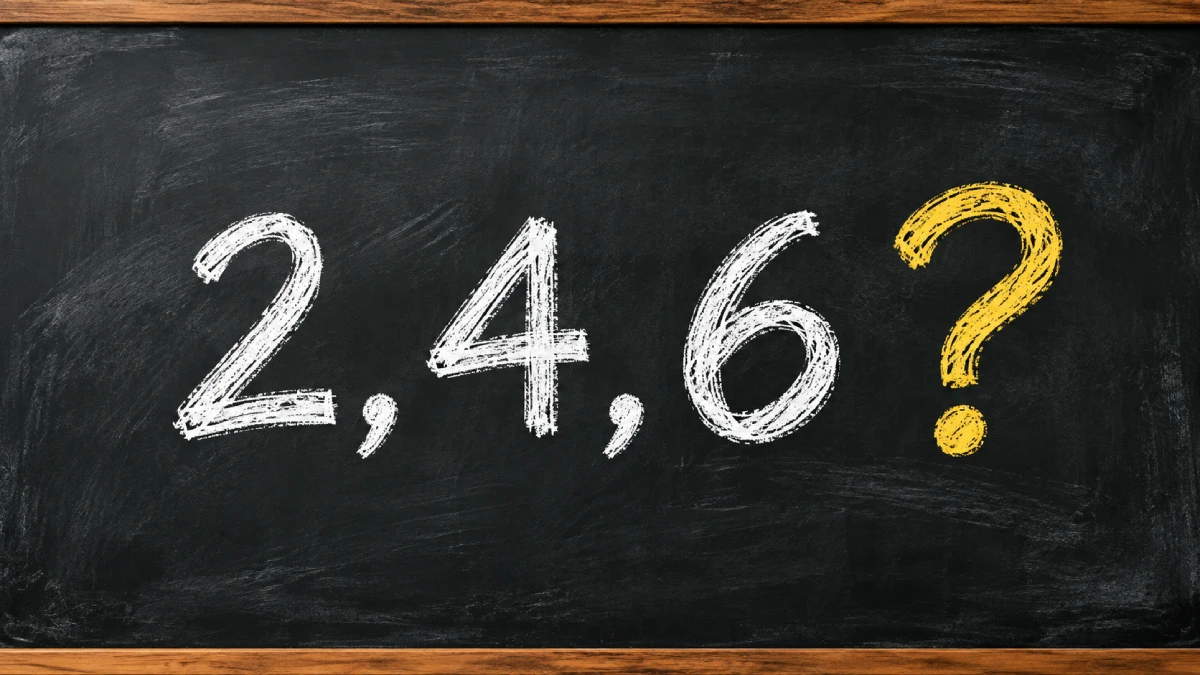

The easiest evidence to find is the evidence you were hoping for.
In 1960, Peter Wason, a psychologist at University College London, set a puzzle that became the classic demonstration of confirmation bias. He wrote down three numbers: 2, 4, 6. They follow a rule, he said. Find it. Suggest three numbers and I will say whether they fit. When you feel sure, announce the rule.
A typical attempt goes like this. The theory forms at once: even numbers going up by two. 8, 10, 12? Yes. 20, 22, 24? Yes again. Confident, the student announces the rule.
That rule is wrong. Wason’s rule was simply any three numbers in ascending order. Only 6 of his 29 participants found it without first announcing a wrong answer. Most of the rest kept testing with numbers that fitted their theory. Few tried 1, 2, 3 or 6, 4, 2, the kind of test that could have proved them wrong.
Confirmation bias is the tendency to search for, interpret and remember information in ways that support what we already believe. We test ideas with cases we expect to pass, and we go easy on evidence that agrees with us. Peter Wason’s 1960 number puzzle is its best-known demonstration.
Where did confirmation bias come from
The idea is old. In 1620, the English philosopher Francis Bacon wrote in his Novum Organum that once the human mind has adopted an opinion, it draws everything else in to support it, and sets aside or rejects the cases that go against it.
Wason turned Bacon’s observation into an experiment. He was working in a Medical Research Council research group at University College London, and his 1960 paper had a plain title: “On the failure to eliminate hypotheses in a conceptual task“. His point was about method. There are two ways to test an idea. You can collect cases that agree with it, or you can hunt for cases that would break it. Only the second can tell you that you are wrong. Wason designed the 2-4-6 puzzle so that the first approach would almost always fail, because the real rule was broader than the obvious guess and the supply of numbers was endless.
The results bothered him. Of his 29 participants, 13 announced one wrong rule before getting it right, and nine announced two or more. Those nine, he concluded, were unable or unwilling to test their own ideas. The phrase “confirmation bias” is usually credited to Wason.
Later researchers found the same habit working on how we read evidence, not only how we gather it. In 1979, Charles Lord, Lee Ross and Mark Lepper at Stanford University recruited 48 students who held strong views on the death penalty, some for it and some against. Each student read the same two invented studies: one suggesting the death penalty deters murder, one suggesting it does not.



Both groups judged the study that agreed with them as better designed and more convincing. They found flaws in the other one. Having read identical, balanced evidence, the two sides reported moving further apart, not closer. The researchers called this biased assimilation.
Today “confirmation bias” is used loosely for all of this: how we search, how we judge what we find and what we remember afterwards. Wason’s original finding was the narrowest of these, about searching. The wider claim rests on later work like Lord, Ross and Lepper’s.
Confirmation bias examples from forensics to the office
On 11 March 2004, bombs on commuter trains in Madrid killed 191 people. Spanish police found a fingerprint on a bag of detonators and shared it with the FBI. A computer search threw up possible matches, and FBI examiners settled on one: Brandon Mayfield, a lawyer in Portland, Oregon. They called it a match. So did an outside expert brought in for the court case.
Mayfield was arrested on 6 May 2004 and held for two weeks. Then Spanish police identified the print as belonging to an Algerian man, Ouhnane Daoud. The FBI withdrew its identification and apologised.
The US Justice Department’s Inspector General investigated, and the report published in 2006 described what went wrong. Mayfield’s print had some unusual similarities to the Madrid print. Once the examiners believed they had their man, they began to “find” details in the blurry Madrid print that were not really there, prompted by what they saw in Mayfield’s print. Ambiguous marks were read as matches. These were trained examiners at the FBI laboratory, and they did what Wason’s participants did with 8, 10, 12.
You meet the same pattern at work. An interviewer who likes a CV asks easier questions, hears confident answers and feels vindicated. A founder sure of a product idea runs a survey among friends and finds, to nobody’s surprise, that people like it.
Online, the effect has help. We choose what to read, follow people who share our views and type search queries that carry our assumptions. “Why is coffee bad for you” and “why is coffee good for you” return very different pages, and each feels like confirmation.
Why do we do it? Confirming is cheaper than disconfirming. It takes less effort to check a case that fits than to imagine one that would not. Being right also feels good, and a search that returns what we expected feels like success.
Is confirmation bias always irrational
Not always, and Wason’s puzzle may flatter its own conclusion.
In 1987, Joshua Klayman and Young-Won Ha argued in Psychological Review that testing cases you expect to fit, which they called a positive test strategy, is often a sensible way to check an idea. It fails badly in one particular situation: when the true rule is broader than your guess, as in the 2-4-6 puzzle. In many real situations, they said, the true answer is narrower than the guess, and positive testing exposes the error quickly. Wason had built a puzzle where the usual shortcut was bound to go wrong.
In 2011, Hugo Mercier and Dan Sperber offered a different defence. They argued that human reasoning may have evolved less for finding truth alone and more for arguing with others. On that view, a person who builds the best case for their own side is doing their job, as long as someone else is testing it. The bias becomes dangerous when nobody plays the other side, which is roughly what happened in the Mayfield case.
The fair reading: confirmation bias is well documented, but the shortcut behind it is not stupid. It works often enough to feel reliable, which is exactly why it catches people out when the stakes are high.
How to overcome confirmation bias
Test your idea with a case that could break it. If you think a new pricing plan will lift sales, ask what result would convince you it had not, and decide that before you look at the numbers.
Write down what would change your mind, in advance. After the fact, almost any evidence can be read as support.
Separate the person who forms the theory from the person who checks it. After the Mayfield case, the FBI revised its fingerprint procedures, including rules for blind verification, where a second examiner checks the print without knowing the first examiner’s conclusion. Any team can borrow that. Ask a colleague to review the evidence before telling them what you think it shows.
When you search, search for the opposite. Type the question that would prove you wrong and read the best answer, not the weakest.
Look for the other side’s strongest argument. Mercier and Sperber’s point cuts both ways: you reason better when someone who disagrees with you is in the room.
A test you expect to pass can only make you feel right. A test that could fail is the one that teaches you something.
Daily Reflection
Pick one thing you are sure of about a project or a person today. Name one fact that would prove you wrong, then go and look for it.